
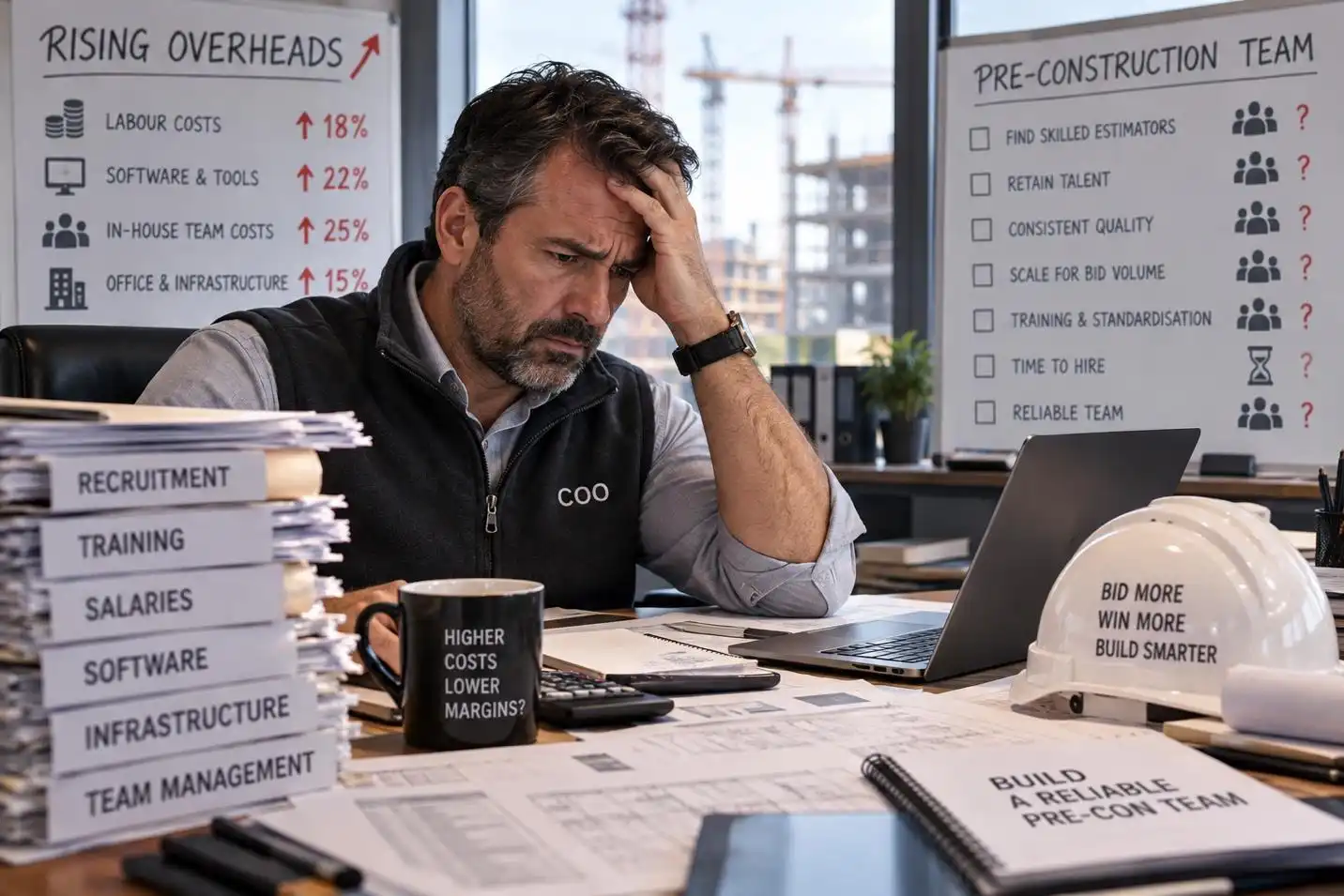
A contractor can have plenty of work and still not need another full-time employee sitting in the office.
That sounds contradictory until the bids start piling up.
One month, an estimating team may have more work than it can handle. The next month, the workload drops back to normal. Hiring locally solves the first problem, but can create another one: fixed headcount for a workload that isn’t always fixed.
This is where remote construction staffing can make sense.
Instead of hiring locally every time the workload increases, contractors can build a remote team around specific parts of their workflow, estimating, quantity take-offs, BIM, CAD, MEP drafting, documentation or scheduling, and keep the core commercial and project decisions with their internal team.
The goal isn’t to create a second company somewhere else.
It’s to give your existing team more capacity without making every increase in workload a hiring decision.
The short answer
Yes, contractors can build effective remote construction teams without hiring locally- but only when the work is suitable for remote delivery and the team is integrated properly.
The most practical starting point is usually work that is:
- Digital rather than site-dependent
- Repetitive or production-heavy
- Easy to define through clear deliverables
- Supported by drawings, models or project data
- Capable of being checked through a structured QA process
That makes functions such as estimating, quantity take-offs, BIM, CAD, MEP drafting, shop drawings and construction documentation particularly suitable.
The mistake is thinking that remote staffing simply means finding someone overseas and sending them drawings.
It doesn’t.
A successful remote team needs the right people, the right workflow and the right level of control.
Don’t build the team around job titles. Build it around bottlenecks.
This is one of the easiest things to get wrong.
Suppose your senior estimator is spending most of the week measuring drawings and preparing quantities. Your first instinct might be to hire another estimator.
But perhaps that isn’t actually the problem.
The bottleneck may be production.
A dedicated take-off specialist could handle the measurement work, while your senior estimator spends more time on scope review, pricing decisions, subcontractor comparisons and commercial risk.
The same thinking applies elsewhere.
If your BIM manager is spending hours updating models, perhaps you need a remote BIM specialist.
If your engineers are losing time producing repetitive drawings, a construction drafter may be the better addition.
If your bid team is missing deadlines because nobody has enough time for documentation, adding another production resource may solve the problem without adding another senior position.
In other words, start with:
“Where is our team losing time?”
rather than:
“Which person should we hire?”
Which construction roles work well remotely?
Not every construction role belongs in a remote team.
A site superintendent needs to be on site. A site inspection cannot be completed from another
country. But a surprising amount of preconstruction and technical production work can be
performed remotely when the process is properly structured.
Construction estimators
- Estimators can remotely support:
- Quantity take-offs
- BOQs
- Tender preparation
- Drawing reviews
- Scope comparisons
- Bid tabulation
- Preliminary estimates
- Subcontractor scope reviews
For a contractor with fluctuating bid volume, this can be particularly useful.
You can add estimating capacity when the pipeline grows without necessarily committing to another permanent local hire.
Remote BIM specialists
BIM is another natural fit for distributed teams.
A remote BIM specialist can support:
- Revit modelling
- Model updates
- Clash detection
- BIM coordination
- As-built modelling
- Scan-to-BIM
- Model-based quantity extraction
- Construction documentation
The important part is consistency. If your internal team uses a particular modelling standard, naming convention or coordination process, the remote specialist needs to follow the same system.
Construction drafters
Drafting is another area where contractors can create additional capacity remotely.
Depending on the project, a construction drafter may support:
- Shop drawings
- Fabrication drawings
- Architectural details
- Structural drawings
- MEP drawings
- As-built drawings
- Drawing revisions
Again, the objective isn’t to hand over an entire project and hope for the best.
It’s to define what the drafter owns and where the internal team takes over.
The best remote team is usually invisible
This might sound strange, but it is a useful test.
If your remote estimator is constantly asking:
“What should I do with this drawing?”
or your BIM specialist is repeatedly asking:
“Which template should I use?”
the problem may not be the person.
The workflow hasn’t been transferred properly.
A good remote construction staffing model should eventually feel ordinary.
The remote team knows where the drawings are.
They know which revision to use.
They know the required output.
They know who to ask when something is unclear.
They know what needs QA before it reaches the contractor.
And your internal team doesn’t have to explain the same process every morning.
That’s when remote staffing starts becoming genuinely useful.
Start with a workflow, not a headcount
Before deciding that you need three people, map the work.
For example:
Bid received → Drawing review → Quantity take-off → BOQ → Pricing → Internal review → Submission
Now ask:
- Which steps require local knowledge?
- Which require senior commercial judgement?
- Which are production-heavy?
- Which can be completed digitally?
- Which need a second technical review?
You may discover that only one or two steps actually need additional capacity.
That is a much better starting point than simply deciding to “hire an offshore team.”
What should stay with the contractor?
Remote staffing works best when responsibility is divided deliberately.
For example:
| Contractor’s internal team | Remote team |
|---|---|
| Bid strategy | Drawing review |
| Client communication | Quantity take-offs |
| Final pricing decisions | BOQ preparation |
| Commercial risk | BIM modelling |
| Contract decisions | CAD drafting |
| Final approval | Documentation |
| Final tender submission | Production support |
This isn’t a fixed formula.
A contractor may eventually hand over more responsibility as the team becomes familiar with its standards and expectations.
But starting with clear boundaries reduces risk.
The part contractors underestimate: QA
Most discussions about remote staffing focus on cost or availability.
The more important question is:
How will you know the work is right?
A good QA process doesn’t need to be complicated.
For estimating, it could mean:
Drawing review → Take-off → Technical check → QA → Contractor review
For BIM:
Model production → Coordination → Clash review → QA → Issue
For drafting:
Drawing production → Internal check → Markups → Revision → Final QA
The exact process will vary, but there should always be a clear point where someone checks the work before it becomes the contractor’s problem.
What does it actually take to manage a remote team?
Less than many contractors expect, provided the process is designed properly.
The remote team should have:
- A clear point of contact
- Defined deliverables
- Agreed turnaround times
- Access to the required software
- Standard templates
- Drawing and revision protocols
- A documented QA process
- A predictable communication rhythm
You don’t need to spend the entire day on video calls.
In fact, if a manager has to constantly monitor a remote team, the underlying process probably needs work.
The better goal is visibility without micromanagement.
A simple example
Imagine a contractor normally has five estimators.
They receive a large tender package with a short submission deadline.
The problem isn’t that the contractor doesn’t have enough experienced estimators.
The problem is that all five are already busy.
Instead of immediately hiring another local estimator, the contractor adds a dedicated remote resource to handle:
- Drawing measurement
- Quantity take-offs
- BOQ preparation
- Revision tracking
The internal estimators continue to handle:
- Scope decisions
- Pricing
- Risk
- Subcontractor engagement
- Final review
The additional resource hasn’t replaced an estimator.
It has removed production work from the estimator’s desk.
That distinction is often where the real value of construction staffing lies.
Offshore construction staffing doesn’t have to mean “cheap labour”
This is another misconception worth addressing.
If the only reason for building an offshore team is a lower hourly rate, the model is unlikely to deliver much value.
The better question is:
How much productive capacity can this resource add to the business?
A technically strong estimator who reduces the workload on your senior team may be more valuable than a cheaper resource who requires constant correction.
The calculation should therefore include more than the hourly rate.
Consider:
Resource cost + management time + rework + delays + missed opportunities
That gives a much more realistic picture.
How Precon approaches remote construction staffing
At Precon, the model is built around the contractor’s existing workflow rather than asking the contractor to adapt to a generic outsourcing process.
For example, a contractor may start with one dedicated estimator handling take-offs and BOQs.
As the working relationship develops, the same model can expand into BIM, CAD, MEP or other
technical support where there is a genuine workload requirement.
The contractor retains control over its projects, commercial decisions and final deliverables.
The remote team provides additional production capacity around that core team.
That is usually the simplest way to make the model work.
A practical checklist before you hire
Before bringing a remote construction professional into your team, make sure you can answer:
Scope
- What exactly will this person own?
- What will remain with the internal team?
- What does a completed deliverable look like?
Technical capability
- Which software do they need?
- What project types should they understand?
- Which standards or measurement methods will they follow?
Workflow
- Where will drawings and models be stored?
- How will revisions be communicated?
- Who assigns and reviews the work?
Quality
- Who checks the work?
- What happens when something is unclear?
- What is the process for correcting errors?
Communication
- Who is the main point of contact?
- How often should progress be reported?
- How quickly should urgent issues be escalated?
If those questions have clear answers, you’re already much closer to building a remote team that works.
Common mistakes to avoid
Hiring for availability instead of capability
Someone being available immediately doesn’t mean they are suitable for your project type.
Sending work without context
A folder full of drawings isn’t a scope.
Measuring activity instead of output
The number of hours worked matters less than the quality and completeness of the deliverable.
Starting too big
You don’t need to build a ten-person offshore department on day one.
Start with one clearly defined function. Prove the workflow. Then expand.
Keeping everything in the contractor’s head
If your estimator has to explain the same process every time someone new joins, document it.
Templates and standards are what make remote teams scalable.
The real question isn’t local vs remote
There is a tendency to frame construction staffing as a choice:
Do we hire locally or outsource?
It doesn’t have to be.
A contractor can have a local project team, an internal estimating department and a remote technical team working alongside them.
The local team handles the work that genuinely requires local presence and decision-making.
The remote team handles production work that can be delivered digitally.
And the contractor gets something that is often more valuable than simply “more employees”:
more capacity when it is actually needed.
That is the real opportunity behind remote construction staffing.
FAQs
Can I hire a construction estimator remotely?
Yes. Estimating activities such as take-offs, BOQs, drawing reviews and bid support can often be performed remotely. The contractor should retain appropriate review and commercial decision-making responsibilities.
What is offshore construction staffing?
It is a staffing model where construction professionals located outside the contractor’s primary market provide defined technical or production support remotely.
What roles can be part of a construction virtual team?
Depending on the workflow, a construction virtual team can include estimators, quantity take-off specialists, BIM specialists, CAD drafters, MEP professionals, schedulers and documentation specialists.
How do I manage a remote BIM specialist?
Give the specialist access to the required models, software, BIM standards, templates and revision procedures. Assign a clear point of contact and establish a defined technical QA process.
Is remote construction staffing suitable for small contractors?
It can be, particularly when the workload fluctuates. A contractor doesn’t necessarily need a large team; one dedicated specialist or a part-time resource may be enough to address a specific bottleneck.
Final Thought
You don’t need to move your entire construction operation offshore to benefit from remote staffing.
Sometimes, the smarter move is much smaller.
Find the part of the workflow that is slowing your team down, determine whether it can be delivered remotely, and add the right specialist around it.
One estimator.
One BIM specialist.
One construction drafter.
One additional pair of hands when the bids pile up.
Done properly, remote staffing isn’t about building a team somewhere else.
It’s about making your existing team more capable of handling the work in front of them.
About the Author
Khushboo Sinha
Associate Director, Global Growth, Precon India
Khushboo works with contractors and construction businesses across international markets, helping them build scalable support teams across estimating, BIM, CAD, MEP and construction documentation.